Rubraqsys
Cipher Guide
Cipher Guide
Couldn't load pickup availability
Problem Statement
After learning basic syntax, many learners find it challenging to combine separate Ruby concepts inside one structured program. Conditions, loops, collections, and methods may be understandable individually but become more demanding when used together. Repeated code can also appear when learners have not yet developed a clear approach to reusable methods. Working with collections introduces additional decisions about how information should be stored, retrieved, and changed. Without organized practice, these topics can remain disconnected instead of forming a coherent programming workflow.
Solution
Cipher Guide introduces these concepts through connected modules that gradually increase the amount of logic used in each exercise. Learners work with methods, parameters, collections, conditions, and iteration in practical combinations. Each section includes focused examples followed by tasks that encourage independent code writing. The course also introduces ways to separate larger problems into smaller pieces that can be handled individually. This structure supports a more organized approach to reading, planning, and writing Ruby code.
What’s Inside
Module 1 — Working With Methods
Study method definitions, parameters, arguments, return values, and method calls. Exercises focus on moving repeated operations into reusable sections of code.
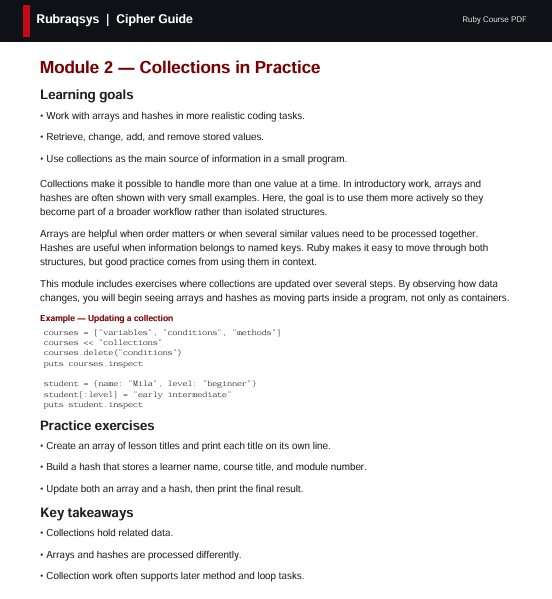
Module 2 — Collections in Practice
Explore arrays and hashes through more detailed tasks involving stored information. Learn how to retrieve, update, remove, organize, and iterate through values.
Module 3 — Conditional Logic
Work with several conditions inside one program. Learners study comparison logic, nested decisions, combined expressions, and different program branches.
Module 4 — Iteration Patterns
Develop familiarity with repeated operations across collections. Practice counters, filters, value changes, calculations, and other common iteration tasks.
Module 5 — Combining Methods and Data
Use methods together with arrays and hashes to process information. Learners practice passing collections into methods and returning processed values.
Module 6 — Breaking Down Problems
Explore how a larger programming task can be divided into smaller logical stages. Exercises focus on planning code before writing individual sections.
Module 7 — Practical Ruby Exercises
Complete several connected tasks that combine methods, conditions, loops, and collections within one program structure.
Who Is This For?
Cipher Guide is intended for learners who already understand basic Ruby syntax, variables, simple conditions, loops, arrays, hashes, and introductory methods.
It may not suit someone encountering programming concepts for the first time, as the course builds directly on foundational Ruby knowledge.
What You’ll Learn
- Create methods with parameters and returned values
- Organize repeated operations into reusable code
- Work with arrays and hashes in broader exercises
- Iterate through stored information
- Combine several conditional expressions
- Use methods to process collections
- Divide programming tasks into smaller stages
- Read multi-step Ruby examples
- Organize program flow more clearly
- Identify unnecessary repetition in code
- Combine multiple Ruby concepts within one exercise
- Develop structured approaches to practical coding tasks
30-Day Refund Policy
Refund requests for eligible paid Rubraqsys courses may be submitted within 30 days of purchase, subject to the refund terms stated by the store.
Self-paced learning overview
- 📥 Digital file available after purchase
- 🗂️ Long-term availability
- 🔒 Secure checkout
- 📝 Content updated in 2026
What format do Rubraqsys courses follow?
What format do Rubraqsys courses follow?
Rubraqsys courses are organized into structured lessons, topic-based modules, practical exercises, and supporting materials. Each course follows its own scope, allowing learners to study Ruby concepts in an organized sequence.
Can I study at my own pace?
Can I study at my own pace?
Yes. The materials are designed for self-paced study, so learners can review explanations, repeat exercises, and spend additional time on topics that require deeper attention.
Do I need previous Ruby knowledge?
Do I need previous Ruby knowledge?
That depends on the course tier. Earlier tiers introduce foundational concepts, while later tiers explore broader programming structures, code organization, reusable components, and more detailed practical tasks.
Share