Rubraqsys
Free Capsule
Free Capsule
Couldn't load pickup availability
Problem Statement
Starting Ruby without a clear learning structure can make individual concepts feel disconnected from one another. A learner may understand a variable or condition separately while still finding it difficult to see how several elements work together inside one program. New syntax can also become harder to remember when it is studied without short practical examples. Moving between unrelated topics may create gaps in understanding and make later material harder to follow. A structured introduction can help learners build an organized picture of how basic Ruby code is written and read.
Solution
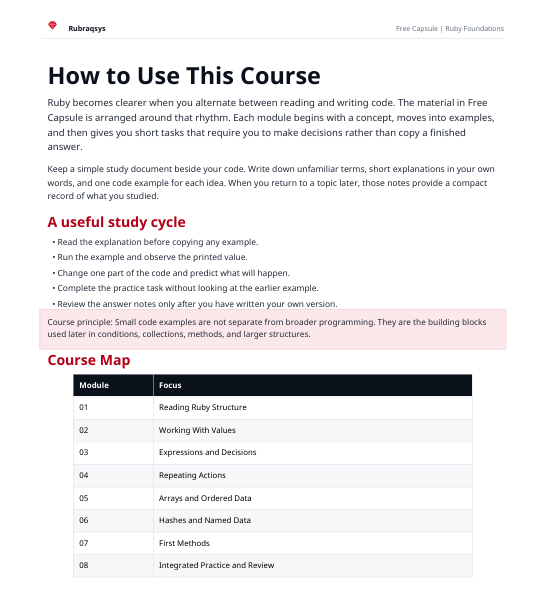
Free Capsule arranges introductory Ruby topics in a gradual sequence that connects one concept with the next. Short explanations are paired with small coding tasks so learners can observe how each idea behaves in practice. The course begins with basic code structure before introducing decision-making, repeated actions, collections, and simple reusable methods. Exercises encourage learners to read existing code as well as write their own short examples. The overall structure provides a practical foundation for continuing into broader Rubraqsys course materials.
What’s Inside
Module 1 — Reading Ruby Structure
Learn how Ruby code is arranged and how individual statements form a program. This module introduces values, variables, naming conventions, basic expressions, and the general flow of simple code.
Module 2 — Working With Values
Explore strings, numbers, Boolean values, and basic operations. Learners practice storing information in variables, changing values, combining expressions, and observing how different data types behave.
Module 3 — Decisions in Code
Study conditional structures and learn how a program can respond to different situations. Exercises cover comparison operators, logical expressions, and simple decision branches.
Module 4 — Repeating Actions
Learn how repetition can reduce repeated code. This section introduces common loop structures and small exercises involving counters, collections, and repeated calculations.
Module 5 — Collections
Explore arrays and hashes as ways of organizing groups of information. Learners practice retrieving, changing, adding, and reviewing stored values.
Module 6 — First Methods
Study how methods divide code into reusable sections. Learners work with method definitions, parameters, returned values, and short examples that combine earlier topics.
Who Is This For?
Free Capsule is intended for learners beginning their study of Ruby, people returning to programming fundamentals, and learners who want to review basic Ruby structures before choosing a broader course tier.
It may not suit learners who are already working comfortably with larger Ruby programs, detailed object-oriented structures, or more developed application logic.
What You’ll Learn
- Read and write basic Ruby syntax
- Create and update variables
- Work with strings, numbers, and Boolean values
- Use comparison and logical operators
- Write conditional structures
- Create basic loops
- Organize information with arrays and hashes
- Define simple methods
- Pass values into methods
- Read short Ruby code examples
- Combine several foundational concepts in small exercises
- Identify common structural mistakes in introductory code
30-Day Refund Policy
A 30-day money-back policy applies to eligible paid Rubraqsys courses according to the store’s stated refund terms. Free Capsule is provided without a course fee, so no payment is required for this tier.
Self-paced learning overview
- 📥 Digital file available after purchase
- 🗂️ Long-term availability
- 🔒 Secure checkout
- 📝 Content updated in 2026
What format do Rubraqsys courses follow?
What format do Rubraqsys courses follow?
Rubraqsys courses are organized into structured lessons, topic-based modules, practical exercises, and supporting materials. Each course follows its own scope, allowing learners to study Ruby concepts in an organized sequence.
Can I study at my own pace?
Can I study at my own pace?
Yes. The materials are designed for self-paced study, so learners can review explanations, repeat exercises, and spend additional time on topics that require deeper attention.
Do I need previous Ruby knowledge?
Do I need previous Ruby knowledge?
That depends on the course tier. Earlier tiers introduce foundational concepts, while later tiers explore broader programming structures, code organization, reusable components, and more detailed practical tasks.
Share