Rubraqsys
Lattice Archive
Lattice Archive
Couldn't load pickup availability
Problem Statement
As Ruby programs become larger, keeping every operation inside a few methods can make code difficult to organize. Learners may understand individual commands but still struggle to decide where different responsibilities should belong. Repeated structures can also appear when related data and behavior are not grouped logically. Classes and objects introduce a different way of thinking about how information can be represented inside a program. Without guided practice, these concepts may feel abstract and disconnected from earlier Ruby knowledge.
Solution
Lattice Archive introduces object-oriented ideas through practical examples that build directly on familiar Ruby concepts. Learners begin by creating simple classes before adding attributes, methods, and relationships between objects. Each module focuses on one structural idea and then connects it with previous topics such as collections and conditional logic. Exercises encourage learners to organize code according to responsibility rather than placing every operation in one area. The course gradually develops a clearer understanding of how larger Ruby structures can be planned and maintained.
What’s Inside
Module 1 — Classes and Objects
Explore how classes describe structures and how objects represent individual instances. Practice creating objects, assigning values, and calling methods connected with them.
Module 2 — Instance Data
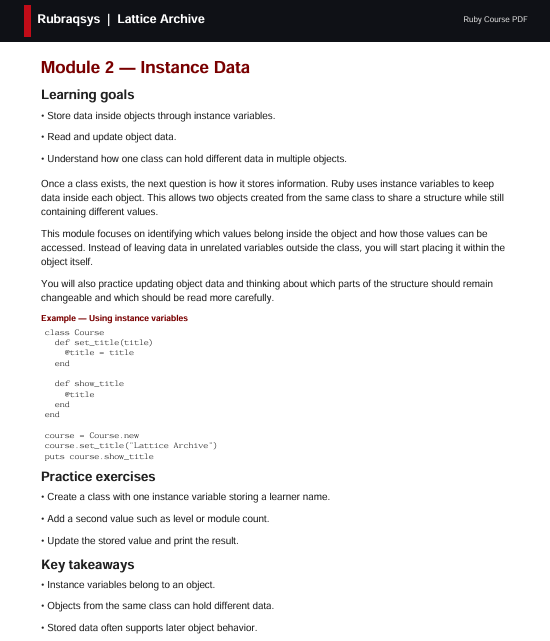
Study instance variables and methods used to manage object information. Exercises include storing, reading, and changing values inside different objects.
Module 3 — Initializing Objects
Learn how initialization methods prepare new objects with specific data. Practice working with parameters and creating multiple objects with different values.
Module 4 — Object Behavior
Explore how methods describe actions connected with an object. Learners create small structures where information and related operations remain grouped together.
Module 5 — Working With Object Collections
Combine arrays and hashes with objects. Practice storing multiple objects, iterating through them, filtering values, and applying methods to selected entries.
Module 6 — Relationships Between Classes
Study how separate classes can work together inside one Ruby structure. Exercises focus on passing objects between methods and separating responsibilities.
Module 7 — Structural Practice
Build several compact Ruby exercises that combine classes, methods, collections, conditions, and iteration into organized program structures.
Who Is This For?
Lattice Archive is intended for learners who already understand Ruby syntax, methods, conditions, iteration, arrays, and hashes and want to explore code organization through classes and objects.
It may not suit complete beginners who have not yet worked with foundational Ruby structures.
What You’ll Learn
- Create and use Ruby classes
- Build individual objects from class definitions
- Work with instance variables
- Define object methods
- Initialize objects with stored information
- Organize related data and behavior
- Store objects inside collections
- Iterate through groups of objects
- Connect separate classes
- Divide responsibilities between code structures
- Read object-oriented Ruby examples
- Build structured exercises using several Ruby concepts together
30-Day Refund Policy
Refund requests for eligible paid Rubraqsys courses may be submitted within 30 days of purchase, subject to the refund terms stated by the store.
Self-paced learning overview
- 📥 Digital file available after purchase
- 🗂️ Long-term availability
- 🔒 Secure checkout
- 📝 Content updated in 2026
What format do Rubraqsys courses follow?
What format do Rubraqsys courses follow?
Rubraqsys courses are organized into structured lessons, topic-based modules, practical exercises, and supporting materials. Each course follows its own scope, allowing learners to study Ruby concepts in an organized sequence.
Can I study at my own pace?
Can I study at my own pace?
Yes. The materials are designed for self-paced study, so learners can review explanations, repeat exercises, and spend additional time on topics that require deeper attention.
Do I need previous Ruby knowledge?
Do I need previous Ruby knowledge?
That depends on the course tier. Earlier tiers introduce foundational concepts, while later tiers explore broader programming structures, code organization, reusable components, and more detailed practical tasks.
Share